


Hello friends,
My handle is Antinoo or Antinous.
I am original from Asia, and my friends and family call me with that name, who remember the lover of an Emperor of the Roman Empire, incredibly famous in my country.
Yes, I am gay, and I am interested in the LGBTD+ community from all over the world no matter the nationality, color of the skin, religion, and sex or political preferences.
I love writing very much, especially about my fantasies, and stories related with myself.
I will also like to post some nice pics, and movies, of cuties and sensual guys. Especially if they have a fit body a pleasant appearance and a nice face. Young or older doesn’t matter.
I hope will have an enjoyable time together and you will like my posts.
To begin and introduce myself I would like to give you some information about my handle, Antinoo, and his own incredibly old story.
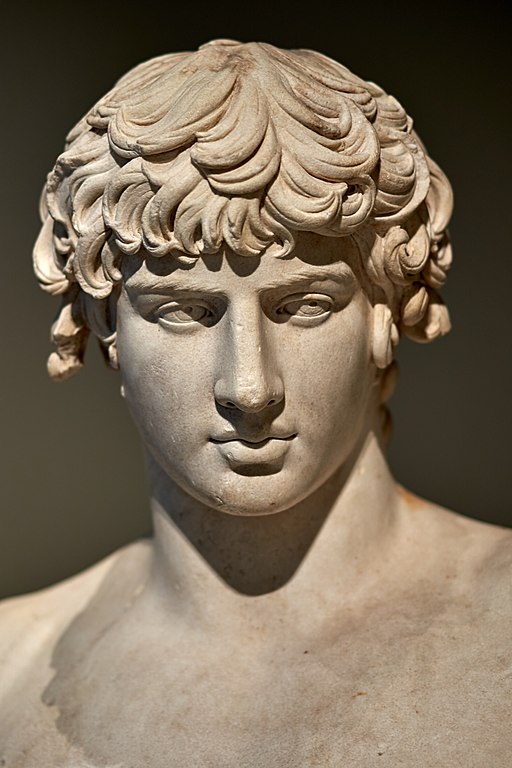
Antinous, also called Antinoös, (/ænˈtɪnoʊʌs/; Ancient Greek: Ἀντίνοος; c. 111 – c. 130) was born to a Greek family near the city of Claudiopolis, which was in the Roman province of Bithynia,in what is now north-west Turkey.
He was born in the territory to the east of the city called Mantineion, a rural locality: the year of Antinous's birth is not recorded, although it is estimated that it was between 110 and 112 CE. Early sources record that his birthday was in November, and although the exact date is not known, Royston Lambert, one of Antinous's biographers, asserted that it was on 27 November.
Given the location of his birth and his physical appearance, it is likely that part of his ancestry was not Greek.
The Emperor Hadrian spent much time during his reign touring his empire, and arrived in Claudiopolis in June 123, which was probably when he first encountered Antinous.
Given Hadrian's personality, Lambert thought it unlikely that they had become lovers at this point, instead suggesting it probable that Antinous had been selected to be sent to Italy, where he was schooled at the imperial paedagogium at the Caelian Hill.
Hadrian meanwhile had continued to tour the empire, only returning to Italy in September 125, when he settled into his villa at Tibur. It was at some point over the following three years that Antinous became his personal favourite, for by the time he left for Greece three years later, he brought Antinous with him in his personal retinue.
The way that Hadrian took the boy on his travels, kept close to him at moments of spiritual, moral, or physical exaltation, and, after his death, surrounded himself with his images, shows an obsessive craving for his presence, a mystical-religious need for his companionship.
Lambert described Antinous as "the one person who seems to have connected most profoundly with Hadrian" throughout the latter's life. Hadrian's marriage to Sabina was unhappy, and there is no reliable evidence that he ever expressed a sexual attraction for women, in contrast to much reliable early evidence that he was sexually attracted to boys and young men.
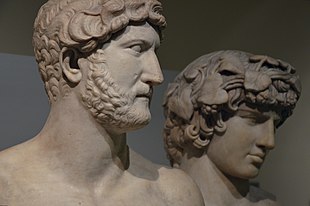
It is known that Hadrian believed Antinous to be intelligent and wise, and that they had a shared love of hunting, which was seen as a particularly manly pursuit in Roman culture. Although none survive, it is known that Hadrian wrote both an autobiography and erotic poetry about his boy favourites; it is therefore likely that he wrote about Antinous. During their relationship, there is no evidence that Antinous ever used his influence over Hadrian for personal or political gain.
In late September or early October 130, Hadrian, and his entourage, among them Antinous, assembled at Heliopolis to set sail upstream as part of a flotilla along the River Nile. The retinue included officials, the Prefect, army, and naval commanders, as well as literary and scholarly figures. Possibly also joining them was Lucius Ceionius Commodus, a young aristocrat whom Antinous might have deemed a rival to Hadrian's affections. On their journey up the Nile, they stopped at Hermopolis Magna, the primary shrine to the god Thoth. It was shortly after this, in October 130 – around the time of the festival of Osiris – that Antinous fell into the river and died, probably from drowning.
Hadrian officially announced his death, with gossip soon spreading throughout the Empire that Antinous had been intentionally killed. The nature of Antinous's death remains a mystery to this day; however, various speculations have been put forward.
Hadrian was devastated by the death of Antinous, with contemporaries attesting that he "wept like a woman." In Egypt, the local priesthood immediately deified Antinous by identifying him with Osiris due to the manner of his death.
In keeping with Egyptian custom, Antinous's body was probably embalmed and mummified by priests, a lengthy process which might explain why Hadrian remained in Egypt until spring 131. While there, in October 130, Hadrian proclaimed Antinous to be a deity and announced that a city should be built on the site of his death in commemoration of him, to be called Antinoöpolis.
Emperor Hadrian established quinquennial games and annual celebrations in honour of Antinous which were called Antinoea (τὰ Ἀντινόεια).
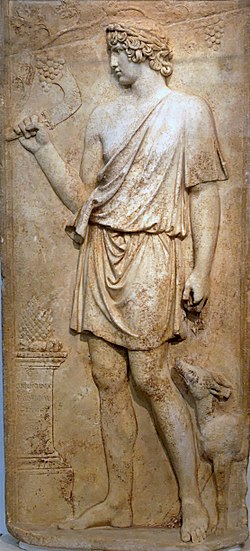
Antinoo


Enter the archive: a celebration of queer desire, bodies, and collective intensity.
Entra en el archivo: una celebración del deseo queer, los cuerpos y la intensidad colectiva
Entra nell’archivio: una celebrazione del desiderio queer, dei corpi e dell’intensità collettiv